
There is a collaboration that exists between the Spire office and our professional affiliates who create our client’s residential and commercial spaces. Interdisciplinary collaboration is one of the many qualities that sets our office apart and allows our work to be integrated seamlessly into the lives of those who use them.
Engineering and design thinking are not customarily tandem, but in our office they have become synonymous. The drive for this dichotomy comes from the true need for incorporation of technology into all aspects of the design process to create a final unified product. Since our systems control all aspects of the physical and experiential space (heating, cooling, audio, visual, security, etc.) there needs to be a synergy between the spaces that are created by our partner architects and designers and the technologies that we plan on using to control those environments with.
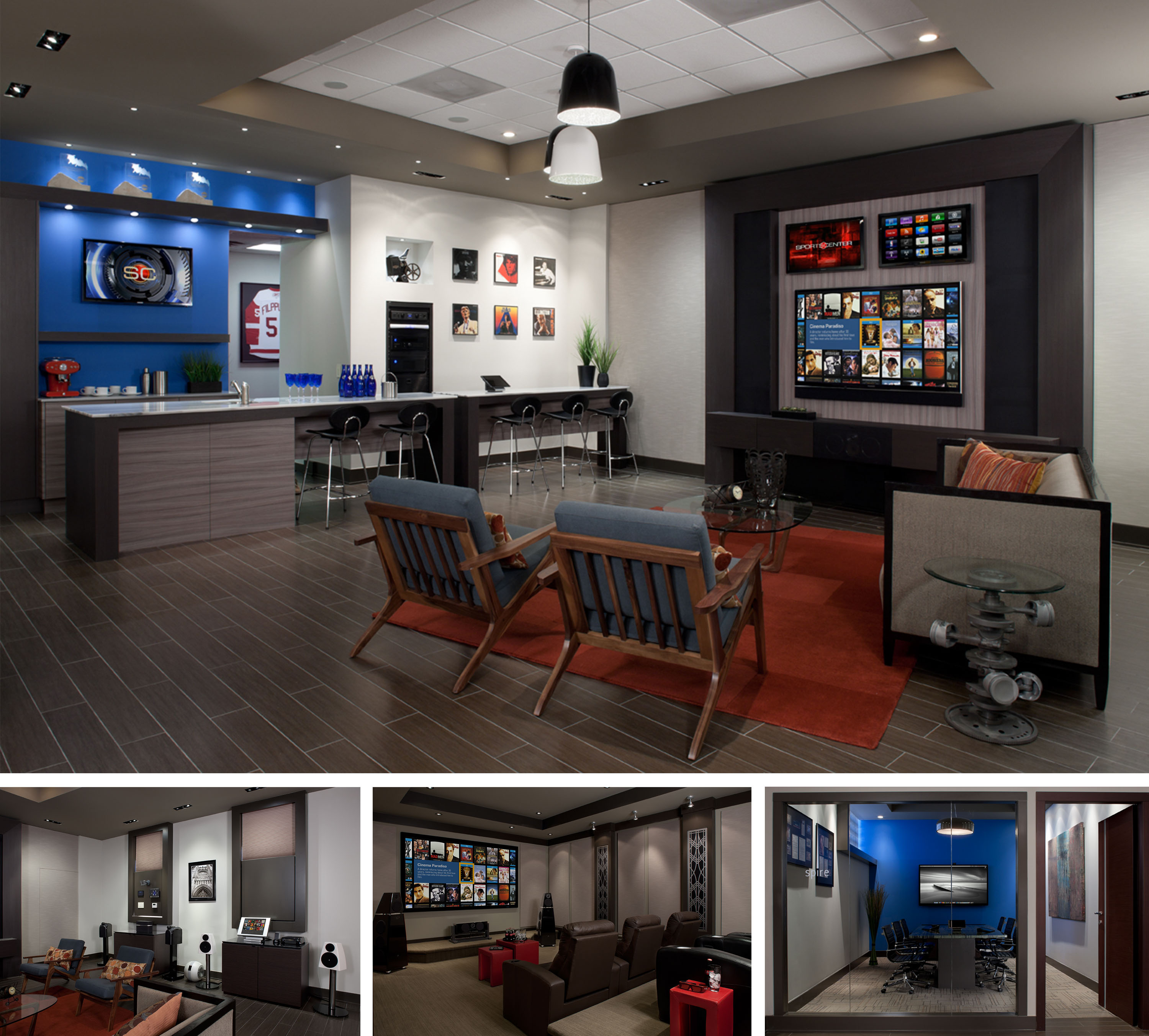
We used the creation of our new showroom as a catalyst to this collaboration. Working closely with our interior designer, the showroom became a physical manifestation of our commitment to the design process. By creating real spaces in which to experience our technology instead of just presenting the control systems as-is, the showroom was designed to feature the technology in true-to-life “rooms.” Clients, designers, and architects are able to fully immerse themselves in the experience of an integrated lifestyle within the walls of our showroom and it helps them to imagine these systems in their own home, helping to make their lives easier.
A blend of design-thinking and partner collaboration is something that many offices don’t have and are working hard to try and adopt. At Spire, I am able to work for a host company that has considered these key factors to be a part of its core values and has developed them both into key strengths. I encourage all young professionals to look at the relationships they have in their office, and with the industries that they partner with and think: “How can I enhance these relationships, and how can I make them efficient?” Creating not only strong relationships with partners, but creating ways to make those relationships work together to create a better final product is key. Efficiency doesn’t just mean creating the same product in less time, it means creating a better product in less time. The bridge between that gap is effective collaboration.