The city of Detroit is a lot of things. At first glance, Detroit is geographically big and diverse. It is also old, iconic, industrial and French. For many, the city of Detroit is a challenge, but if it is anything, Detroit is always more than meets the eye.
I experienced this most recently when I volunteered for the Michigan Historic Preservation Network surveying 6 potential historic districts within Detroit’s city limits. On the surface, this sounds pretty normal: historians taking inventory of a famously historic city. But, like most things in Detroit, this experience was anything but normal. Here’s why:
1. Detroit’s historic districts are not like other historic districts.
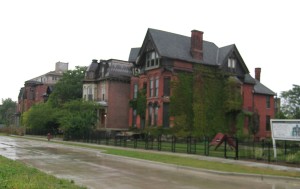
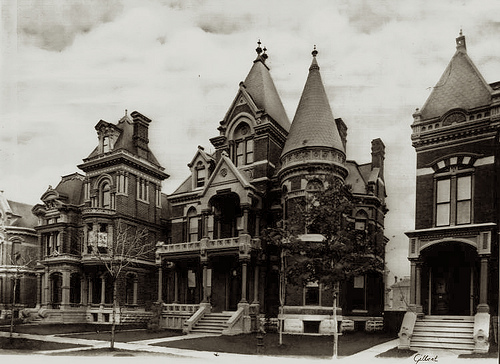
I grew up in a historic neighborhood. My parents both took turns at being on the board of Historic Perrysburg approving any exterior improvements or additions made to properties within the district limits. We even had to get approval to change the shape of our fence. But in Detroit, there are so many historic areas that have never been under the protection of an official historic district, much less a board that oversees neighborhood integrity. And yet, some of the most incredible testaments to architectural history are hidden in neighborhoods better known for their blight. And we got the chance to see them all.
2. This survey was not like other surveys
In most big cities, surveys have become somewhat commonplace. There is the survey being done on the corner to evaluate a stoplight or the survey from the person in the grocery store asking you what you think about the environment. Or it’s one of a hundred exit surveys you’ve done after attending an event in a cool new venue. And yet, not often are there surveys done in collaboration with multiple organizations not for the purposes other than furthering an agenda. This survey of historic districts was done in conjuncture with the Detroit Land Bank Authority, Data Driven Detroit, and Loveland Technologies to help inform important decisions around strategic demolition. Through this partnership, the Michigan Historic Preservation Network was able to take a uniquely proactive role in identifying and preserving eligible historic districts throughout greater Detroit. While the survey does not advise whether or not a property should be considered for demolition, it does provide a better rounded view of a property based on it’s architectural integrity, it’s consistency with the historic features of the neighborhood and the completeness of its block.
3. These surveyors were grassroots at its finest.
The surveyors for this project were not what you might expect. Instead of hired professionals, this was a team of incredibly passionate, intelligent locals with backgrounds ranging from architecture to engineering to environmental studies who simply wanted to see Detroit’s history protected. Each outing became a learning opportunity for those new to the field of preservation, but was also always a teaching experience because everyone had something to contribute. The most incredible part? A small team of entirely volunteers surveyed over 18,000 properties in just over two weeks.
5. This data will do more than other data.
The greatest part about this survey is how much of an impact it is going to have on the future of the City of Detroit. First of all, it will become an important database for identifying and selecting Detroit’s next historic districts. But more importantly, in unprecedented fashion, the data will be aggregated into a single score for each property that allows for the technical and unbiased evaluation of individual parcels and neighborhood blocks for those making strategic demolition decisions. To be entirely cliché, it is history in the making.
And it’s only in Detroit.