
Did you know that according to a 2012 Knight foundation report, 40% of Detroiters lack broadband internet access?! That fact that led to the formation of the digital justice street team, Wi-Detroit in spring of 2013. I was part of the 6 original co-founders of this initiative. We got our start thanks to a conference called the College to Career Pathways hosted by Mobilize.org. Similar to Challenge Detroit, the Mobilize event was fueled by the intent to empower millennials to make a difference in Detroit. I sat at a table with a community-conscious group of individuals dedicated to relevant collaboration as a means to solve our city’s problems.
As conversations about revitalization and Detroit’s growth progressed, our table noticed a pattern in the solutions proposed. They all revolved around ideas that relied on internet access. Opportunities are easy to access online, but only if you have internet access! As for the near 40% of Detroiters without access to the Internet; students, families, and work-ready millennials miss resources available online (networking, education, and job opportunities.) I had just applied for Challenge Detroit a few weeks prior to the Mobilize event and I imagined how difficult it would’ve been without internet access. We quickly pitched our initial street team idea, gained funding and hit the ground running full steam ahead making partnerships, strategies and installing mesh networks.
Now fast forward a year to July 2014, the final culminating month of Challenge Detroit. The fellows were gifted the opportunity to work with an organization of our choosing. I thought, what better way to round out my year than by working with the Wi-Detroit team!?
The fellows had to pick an organization that could benefit from our help, utilizing the design thinking process as a guide for solutions to a challenge it was currently facing. Because Wi-Detroit was founded by a bunch of college and post-grad professionals, the Wi-Detroit challenge was easy to pinpoint. The group’s efforts had been heavily affected by busy schedules, GRE tests, grad school transitions, job stress and even a wedding! Juggling several life events had it’s toll on the original founding members of the team. So much so that Wi-Detroit went from a team of seven to four to three; three women who were all working full time jobs or enrolled in grad school. Decreasing membership affected the efforts of this digital justice initiative and the work had become stagnant for its remaining founders. After all, we’d been working for almost a year and only successfully partnered with one community group in the Brightmoor neighborhood. And we were just starting to partner with Challenge Detroit partner organization, COTS.

The original founders of Wi-Detroit and PassionClass: Detroit
So with my impact project, I proposed the following challenge to my fellow Wi-Detroit teammates:
How might we thoroughly evaluate and assess the current effectiveness of Wi-Detroit in order to course correct the group’s efforts and promote the benefit of the initiative to prospective partners and communities?
There were a few things I did during this challenge to help our group address this question:
First, I interviewed the fellow team members as well as prospective partners, like some of the Detroit Digital Stewards to gain empathy and capture insight. We learned how each group defines and shapes the digital justice scene in Detroit and compared/contrasted that with Wi-Detroit’s current effectiveness.
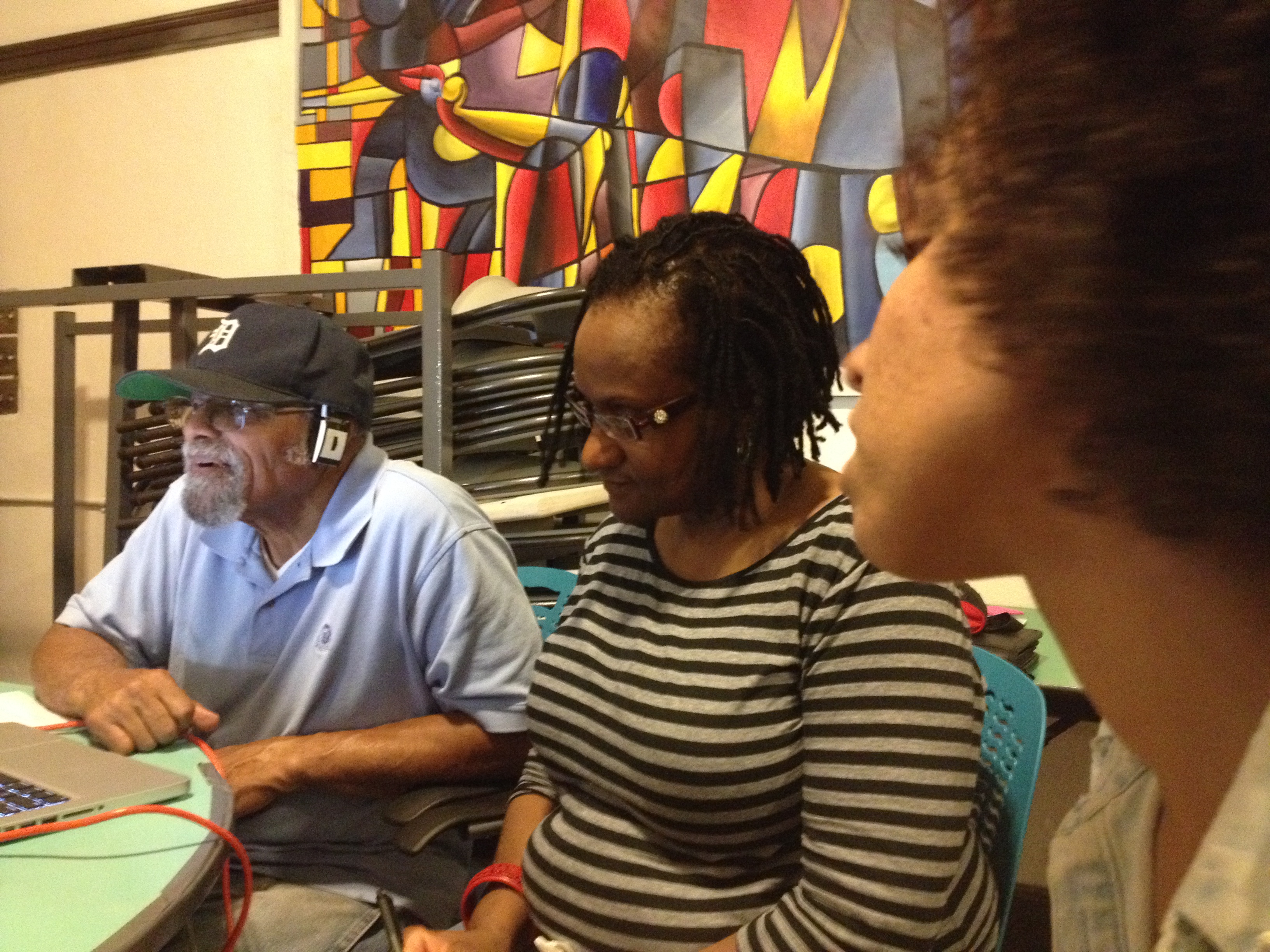
Wi-Detroit co-founder Katie and I learning about the Detroit Digital Stewards and helping them prepare for the Allied Media Conference
After that, I worked with my team to evaluate our group’s current progress in 3 areas: Brand perception, Community Outreach, Strategic Partnerships and used these findings to create an efficiency report.
After these steps, we discovered that Wi-Detroit had been investing its remaining energy in the wrong areas. Since losing the tech guru and the community organizer we realized that our muscle for meeting the community’s immediate needs weren’t as strong as they once were. However what we realized is that the remaining founders have strengths in the areas of marketing, branding and strategy coupled with an extensive professional network in the city.
With this insight we were able to remodel the group strategy and mission to one where Wi-Detroit serves as a convener of resources for existing digital justice stewards/groups on the ground working to alleviate the problem. Why reinvent the wheel when you can help others to spin it faster? I created a recommendations report that included the suggestion to shift Wi-Detroit’s focus from directly helping communities to helping the people who are already helping the communities to be more effective (like the amazing Detroit Digital Stewards we interviewed). This strategy alleviates competition over funding and works well with the bandwidth of Wi-Detroit’s remaining members.
With this new direction I was able to create a recommendations reports and a new manifesto that will help Wi-Detroit to re-steer it’s efforts, utilize its strengths to meet its new mission and create a more effective plan for progress and promotion. The best part of this project is that our group has a renewed sense of confidence in our ability to affect change in digital justice for Detroiters.
In junction with our new mission, we hope that you support the Detroit Digital Stewards in their efforts to bridge Detroit’s digital divide. They are currently raising funds to expand their 7 existing community mesh networks. You may ask “why?” But Wi-Detroit asks “Wi-NOT?”! Learn more about their amazing work and current campaign here!