
Detroit is in crisis, and not that many people are talking about it. The prevailing Detroit narrative we see day-to-day in the media is one of resurgence and revitalization, of development and growth – one that blatantly ignores the reality currently faced by 93,733 native Detroiters. Their Detroit is one that may, due to unpaid property taxes, forcibly evict them from their homes by March 31st. That’s 93,733 Detroiters who may be kicked out of their homes, whether or not they have places to go. By March 31st. Of this year.
If you haven’t heard too much about the tax foreclosure crisis up to this point, I wouldn’t be too surprised. Shinola’s Detroit-made watches and that new restaurant opening its doors in Corktown make far sexier headlines. Even Buzzfeed lists have gotten more publicity as of late.
So, what’s the deal with this whole tax foreclosure thing? What qualifies it as a crisis?
Foreclosure is the process of taking possession of a mortgaged property as a result of the mortgagor’s failure to keep up mortgage payments (thank you, Google). On March 31st, Wayne County plans to auction off properties that have 3+ years of unpaid property taxes. Currently, there are about 76,000 houses in Detroit that fall into this category. 35,000 of these are occupied by humans.
When you first hear this, the situation may not sound so deplorable. You might feel the foreclosures are justified; we can’t expect some to pay property tax and let others off the hook. However, the stories of the Detroiters facing foreclosure are far more complex, relatable and human in nature.
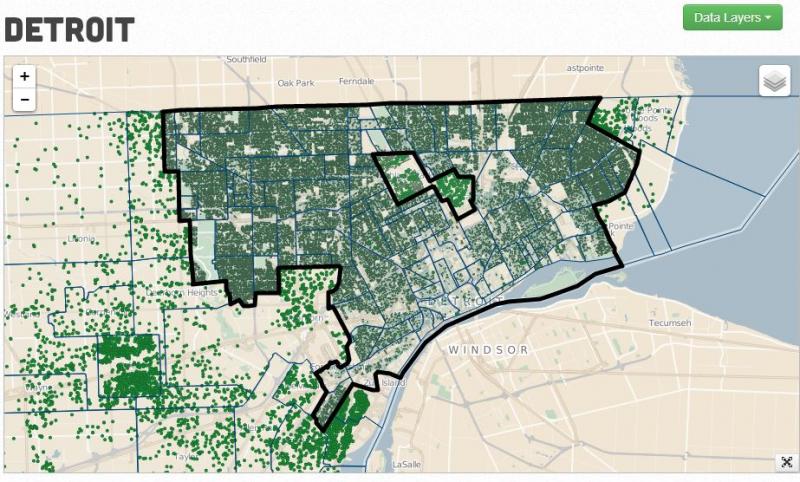
Map showing Detroit properties at risk of foreclosure in 2013
Some Detroiters may rent from landlords who fail to pay city taxes. When the house is foreclosed and auctioned off, the landlord can easily rewind, re-buy the house and repeat the cycle. The tenant, forced to move out with no advance notice and often few options, may not have it so easy. Other Detroiters may inherit houses that, unbeknownst to them, have thousands upon thousands of tax dollars owed to the County. Others still may purchase homes without knowing their properties are behind on taxes, sometimes at a rate worth several times the value of the house itself. The latter situation became all too common after the housing crisis, when real estate investors bought up thousands of homes in Detroit for next to nothing, later selling them off to residents (often low-income, first-time buyers) who, having limited knowledge and experience with real estate, were oft caught completely blind sighted.
The tax foreclosure situation in Detroit is further compounded by 1) the 18% interest rate on past-due taxes (WHAT???) and 2) the fact that, according to Peter Moskowitz, “properties in Detroit are often assessed by the city at values several dozen times their actual worth, reflecting what they might have sold for decades ago, before the city was in financial crisis”. That means, all too often, Detroiters end up owing taxes that are vastly disproportionate to the (low) market value of their homes. Moskowitz shares the story of Krystal Malone, an underemployed substitute teacher who owes the County $9,000 in backpay taxes on a house worth only $10,000.
Clearly, there are some systemic failures at play. The current system may easily (and sometimes unknowingly) trap Detroiters into a cycle of increasing debt and a future of impending foreclosure… as it has done so already this year with 35,000 households.
Among other (negative) consequences, the forcible eviction of 35,000 households may uproot families, hurt communities, erase history and culture, decrease property value and perpetuate blight in a city already struggling with abandonment and instability. In the big picture, the short-term benefits of property taxes paid back to the County will surely be overshadowed by the social, economic and political detriment of uprooting one sixth of the city’s population. Where will these families go? What will happen to their neighborhoods and communities? And who will prevent real estate investors from doing it (buying houses from the tax auction, evading taxes, and either selling or renting to innocent residents) again?
The number of households currently facing foreclosure in Detroit is truly unprecedented (by comparison, a total of 89,000 homes were foreclosed over a ten-year span between 2003 and 2013). And yet, we aren’t really hearing about it. In 2003, Wayne County declared 1,800 foreclosures a major crisis, but in 2015 Mayor Duggan failed to even mention this year’s foreclosures in his State of the City address.
When we hear about Detroit in the news, we need to think not only about who is being featured, but also consider who is being left out. While Detroit can be said to be making a comeback, said “comeback” ought not be considered in the vacuum of Downtown and Midtown, but rather in the context of all 688,000-and-some of its residents. The narratives we hear, and are sometimes a part of, do not always tell the full story.
Check out Because Someone Lives Here to learn more about these Detroiters’ stories and how you can help. Also, here is an interactive database by the New York Times that shows 43,634 properties that were on the brink of foreclosure in 2014.