
I’ve probably been more active on social media in the past month than I have been in the past year. Specifically, I’ve been posting about my new life in Detroit.
At first, I wasn’t sure how I felt about our Challenge Detroit program expectation to post positively about Detroit. As someone with a relatively limited presence on social media (I rarely posted statuses on Facebook, I created a Twitter account once upon a time but never tweeted, and I deleted my Instagram after my first post), I feared that my new activity may be inauthentic and contrived.
Despite (or perhaps in light of) the fact that I spent (wasted) a ton of time in college procrastinating on Facebook, I’ve had mixed feelings about social media for quite some time. While I recognize the role it may play in connecting people across contexts and across countries, I feel that in our society, time spent on social media often ends up making people feel isolated and alone. Several studies suggest this to be true, too. However, in my first month in Detroit, I began to realize the value of sharing my experiences here with my social network – both friends and acquaintances.
Detroit gets such a bad rap in the media – the overwhelming majority of news coverage of Detroit is sensationalist, capitalizing on our crime, blight and bankruptcy to sell papers (or perhaps ads, in this day and age). People like scandal. They are drawn to images of decay. They indulge in ruin porn. Given the media’s skewed portrayal of Detroit, it’s not hard to see why people think so negatively and fearfully of the D. People don’t say nice things about Detroit.
What you don’t see on the news are Detroit’s dreamers and doers, its artists and creatives, its activists and entrepreneurs. What’s missing from the story is its strength, resilience and hope.
In the 1970s, a small business owner by the name of Emily Gail was facing a Detroit not unfamiliar to us today: crime rates w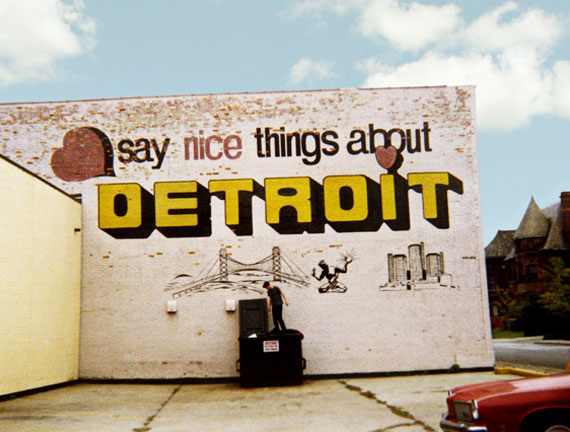 ere among the highest in the nation, local businesses were closing, and people were fleeing the city in droves. To combat the negativity taking over the city, Emily launched a word-of-mouth campaign with the slogan “Say Nice Things About Detroit”. She slapped the slogan onto T-shirts and retail goods, scooped ice cream and sold hot dogs, and organized fun runs that brought together thousands of Detroiters.
Much like Ms. Gail did in the 1970s, I believe that we as Challenge Detroit fellows can help play a role in spreading Detroit positivity to people in the metro Detroit area and beyond. The importance of saying nice things, while seemingly trivial, can go a long way to broadening people’s perspectives and changing their perceptions. Detroit is not a place to be feared. Saying nice things about it might just let its true light shine through the shroud of pessimism.
And so, it is with purpose and positivity that I will continue to say nice things (on social media and beyond!) about the city I am proud to live in: Detroit.