
The racial demographics of Metro Detroit have always intrigued me. As a person who loves learning about different cultures and exploring different worldviews to gain a better understanding of things, it has always fascinated me how our region is so diverse with people from all over the world yet so segregated. I think it’s incredibly amazing that we have communities from all over the world here. It’s like having a little piece of each country in America. However, this leads me to think a lot about how beneficial it would be if our society was more mixed and less segregated. You’re probably wondering how it’s possible for our region to be both segregated and diverse at the same time. That doesn’t make any sense, right? Well, it does make sense in a strange way, so let me explain.
How are diverse yet segregated?
When looking at a race map, it becomes clear that the 8 mile border (one of the borders between Detroit and its suburbs) is an invisible racial dividing line. South of 8 mile (Detroit) is mostly African American while north of 8 mile (some of the Detroit suburbs) the population is mostly white. On a larger scale, this division is between the white and black population, but from what I have seen, this division seems to occur between almost all ethnic groups. We are diverse because here, we have ethnic communities from all over the world. We are segregated because most of the people from these different ethnic groups each live in their own area and don’t tend to mingle with each other very much. We don’t get to know each other’s cultures and break the barriers not because we don’t have the opportunity, but because we don’t make the effort to try.
Don’t get me wrong, I think staying connected to one’s ethnic community is incredibly important and necessary. Being a part of a community definitely has its ups and downs, but being an Indian American born and raised in the United States, knowing there is an Indian community around me has helped. Through my participation in Indian cultural events, my love for Hindi music, Bollywood movies, and Indian outfits, I have been able to stay connected to my culture. However, I think it is equally, if not more important to also step outside of your own community and become immersed in other cultures as well.
Racial Distribution Graphs
(NOTE: The information provided is based on the U.S. Census Bureau’s “Latino or Hispanic and Race” category for each county and city for the year 2010.)
In order to show both the diversity and segregation of Metro Detroit, I have created some pie graphs. These graphs show the racial distribution by percentage in Macomb, Oakland, and Wayne Counties (all three of which make up the Metro Detroit region). I then created pie charts for two or three cities from each county to show how each city is also divided.
 As you can see, when you look at the demographics of Wayne County as a whole, the racial distribution between white folks and African Americans looks pretty even. However, this illusion of an equal racial distribution between white folks and African Americans is deceiving. To show this, I decided to show the demographics of three cities in Wayne County: Detroit, Dearborn, and Hamtramck. In Detroit and Dearborn, the population is skewed towards one race. Hamtramck, on the other hand, is an interesting exception. Although both Detroit and Dearborn are in Wayne County, the demographics of both cities couldn’t be more different.
Detroit has an 82.2% African American population with the Hispanic/Latino and White population showing a smaller presence. (Also keep in mind that this information is from the 2010 census. Nearing 2014, Detroit’s demographics are changing in certain areas of the city due to many factors, however African Americans are still the majority in the city).
Dearborn, only a short distance away (only a 15 minute drive away from Downtown Detroit), has a completely different demographic. Let me point out that Dearborn’s demographics according to the 2010 census are slightly misleading. The census shows the population as 86.7% white which is not completely true. The majority of Dearborn’s population consists of Arab Americans. Unfortunately, Arab Americans do not have a specific category on the census and as a result are required to classify as white. So, the 86.7% white population on the census is actually a combination of both Arab Americans and white Americans. In Metro Detroit, we have one of the largest populations of Arab Americans living outside of the Middle East. While there are groups of Arab Americans concentrated in some other parts of Metro Detroit as well, the majority are largely concentrated in Dearborn.
The demographics of Hamtramck are interesting and is a good example of what I would like to see occur throughout Metro Detroit. The city, almost entirely surrounded by Detroit, except for a small part that borders Highland Park, is possibly one of the most diverse cities in Michigan. That is more than I can say for most other cities in our region. 53% of the population classifies as White, but that demographic includes Arab Americans and Europeans from countries including Poland, Albania, and Macedonia. There is also an Asian American population, many of whom are Bangladeshi Americans, a group of people who are of mixed races, and a small presence of other minority groups as well.

In Oakland County, the demographics show the majority to be white Americans, as expected. After the 75.1% white majority, the next two most visible groups are African Americans (13.5%) and Asians (5.6%). To show an example of how both groups are somewhat segregated within the county, I decided to examine the cities of Troy and Southfield.
Troy has a 19.1% population of Asian Americans, which is actually quite large for a minority group, while there is only a 4% population of African Americans. Every other ethnic group in Troy is barely visible. Southfield, on the other hand is 69.9% African American and has such a low population of Asian Americans that it shows up as 0.0% on the graph. Again, every other minority group has a very small presence.
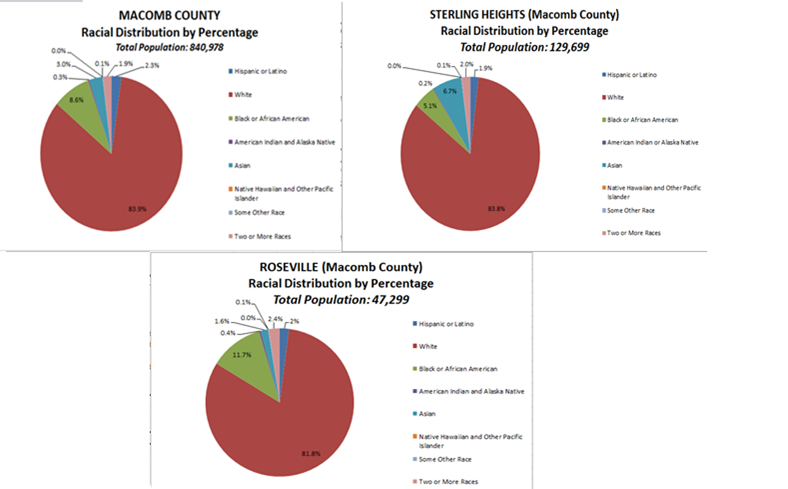 As you can see, Macomb County is primarily white, just as expected. Also is a comparison of the demographics of the cities of Sterling Heights and Roseville. Here, the demographics of both cities are somewhat similar to each other. Unlike most of the cities I compared in Wayne County and Oakland County, the demographics of both cities are also similar to the county as a whole.
In my hometown of Sterling Heights, you will find a little bit of diversity in a couple focused areas of the city. For example, you will find a small group of Albanian Americans and large group of Chaldean Americans (both of whom fall into the white demographic) each living in certain parts of the city.
What does this mean?
I know that there are many factors behind why people choose to settle where they do, but overall, I believe that these statistics show how much unused potential our region has. My point is simply that here in Metro Detroit, we have been given such a great opportunity to expand our horizons and to open our minds. We have so much diversity that we could become one of the strongest regions in the country if we used it to our advantage. In an ideal world, instead of each group living separately, we would all live in a completely mixed society where everyone was open with one another and became immersed in each other’s cultures. This would allow us to be a part of our own ethnic community while also becoming immersed in the other cultures that surrounded us. Each culture has its own strengths and weaknesses, and by immersing ourselves in all cultures, we could not only learn and apply these new lessons to our own lives, but also use the strengths of each culture to strengthen our region as a whole.
Right now, our region may be diverse, but we still have some work to do before we can become a true “melting pot.” Due to a lack of interaction with those who are different, racism, prejudice, and bigotry all still exist. Of course we can never completely eradicate prejudice behavior, but I don’t think most people who are prejudice towards others are bad at heart. I think that it’s ignorance and fear of those who look or act different from them. In a more mixed society, we would be able to get rid of this fear and realize that we all have more in common than we think we do. After all, no matter how different we look or act, in the end we were all created equal.
So, in 2014, I would like to challenge each and every one of you to get out of your comfort zones and do something that you are afraid of or don’t know much about, whether it’s getting to know someone of a different background, or something as simple as getting over a fear of heights and flying. Chances are that your fear is of fear itself and will lessen or disappear altogether once you make the effort to learn. Me? I’m going to attempt to get over my terrible dog phobia (Oh Goddd HELP me!). How? I don’t know, but hopefully someone will be willing to help me.
Happy New Year!
Shivani