
It’s hard to believe July is almost over- tomorrow marks the beginning of our last month as Challenge Detroit Fellows, and the end of our final Challenge. For the past 5 Fridays, we’ve changed up our usual challenge structure of all working with one non-profit partner in favor of individual or small group impact projects. These projects let all of us fellows identify previous or new partners and design our own Challenges, creating an opportunity to impact an organization we care about.
For the past six months, fellow-fellow Miguel Davis and I have been working on our own venture, outside of our host company hours and Challenge Detroit Fridays. This venture – a community coffee shop that uses a retail model to fund micro grants in Detroit – has understandably had to take a back seat to many of our other responsibilities so far, but our July impact project allowed us to dedicate some much needed time and effort to our future coffee shop.
One of the most important things we accomplished this month, was testing and proving some of the key assumptions we had been relying upon in our strategic planning thus far. Initially, much of our market research regarding coffee shops in Detroit was anecdotal and ad hoc: a compilation of experiences, observations, and assumptions we formed with little to no research and data, past our day to day experiences. Many of these assumptions served as a fine starting point and adequate placeholder in the initial planning stages, but we knew we would need more concrete numbers and data points as we move forward.
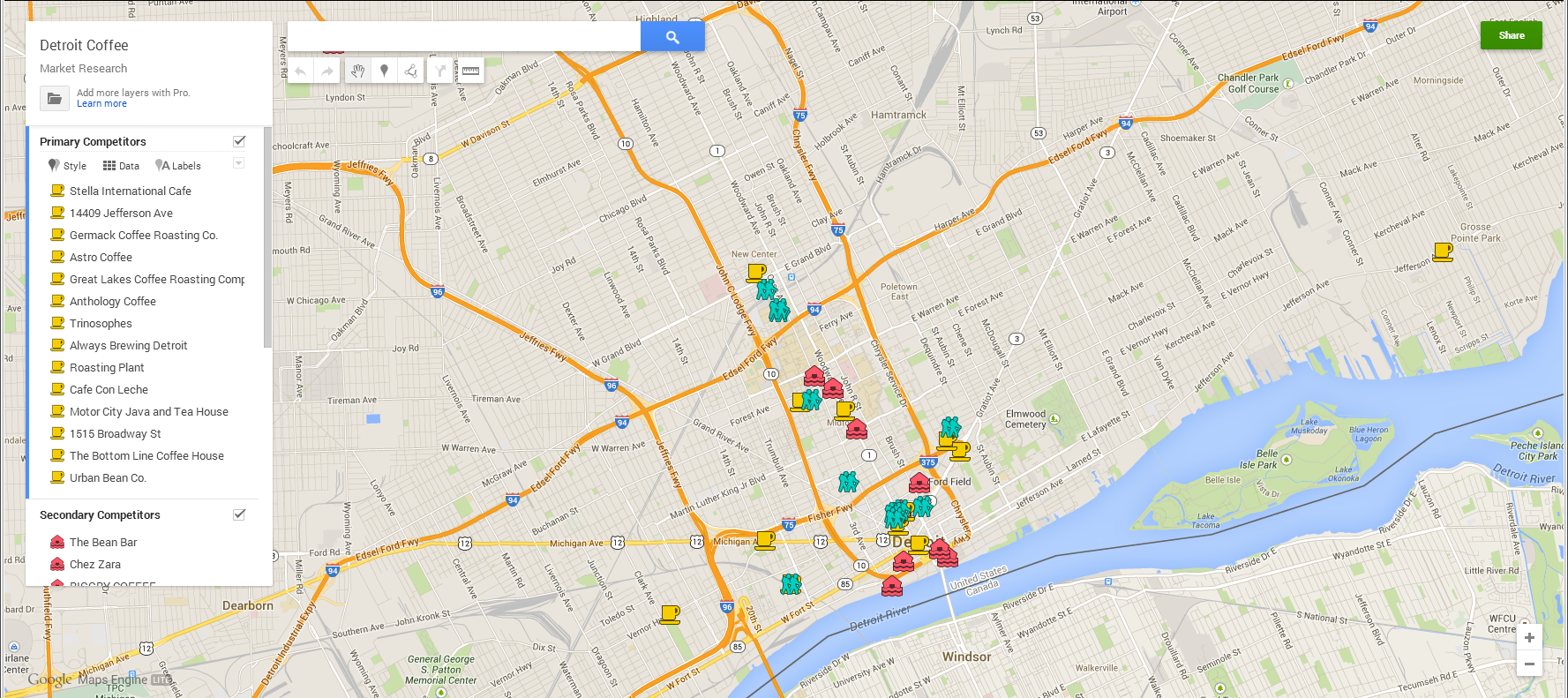
It was from this need that our market research map (or simply ‘coffee map’ as we’ve come to call it) was born. We researched all the coffee shops big and small across the city and plotted them on one central map (thanks google!). What we found confirmed the assumptions we’d already held – that the majority of premium coffee shops were located in a relatively small 6.5 mile stretch of central Detroit – but also offered some interesting points to consider. Our data outliers, coffee shops located far outside the central business district and with little to no caffeinated competition, illustrated the potential space for growth and hinted at population and development trends in the next few years. We also added other info, like competitor’s pricing and popularity and even the location of different sector competitors, like coworking spaces. While we’re still a ways away from actively searching for a physical location, this kind of information will be vital when it is time to decide where exactly our coffee shop will be sprouting up.
Interested in checking our map out for yourself? Great! You can find the map here. This is a living document that we plan to update so it will continue to be useful to our work, and hopefully to other entrepreneurs in Detroit. Did we miss your favorite coffee spot or do you have an idea of other insightful data points we could add? Leave us a comment or send us an email, we would love to hear from you!
P.S. Want to read more about what we did this month? Check out my co-conspirator’s blog too!