
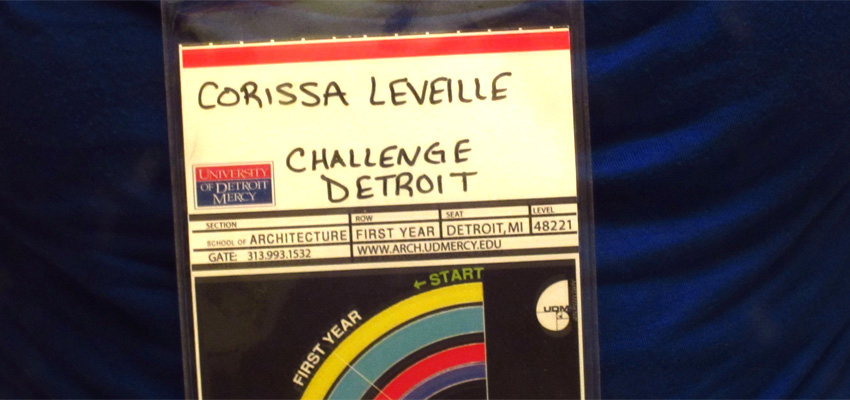
 Every year my Alma mater, the University of Detroit Mercy [UDM] School of Architecture [SOA], hosts a Career Day for perspective students to show them what it would be like to be an Architect. When I was a perspective student, this event involved a panel discussion of 6 licensed architects, well into their careers with the only difference between them being what type of building they had designed [ex: residential, hospitality, arenas, etc]. While this was great at showing what the profession of architecture looked like 50 years ago, it is out of touch with the current architectural environment that my fellow graduates and I were experiencing.
Luckily, 2 years ago, they switched up the program and this year they invited ME to be one of the speakers!
With the new program, the SOA decided that instead of having one large panel discussion, it would be better to have smaller breakout sessions that would revolve around the 4 post-graduate professional categories of an Architect today:
- The Citizen Architect
- The Creative Thinker
- The Architectural Designer
- The Architectural Professional
I was asked to talk about my role as a “Citizen Architect”. At first, I wasn’t sure exactly how I fell into the category of Citizen Architect, or what it actually meant.
For your reference, the American Institute of Architects [AIA] considers a Citizen Architect as:“an individual who uses his/her insights, talents, training, and experience to contribute meaningfully, beyond self, to the improvement of the community and human condition.”
Luckily, two days before I was supposed to present, I had the amazing opportunity to attend the Bruner Loeb Forum on Legacy Cities which coincidentally was also being co-hosted by the Detroit Collaborative Design Center [DCDC] housed in the UDM SOA . During the event, I was able to hear from Roberta Feldman, PhD, an Architect who specializes in the democratic design process and spatial desegregation in architectural environments and Mindy Fullilove, MD, a Clinical Psychiatrist who focuses on the link between urban functions and mental health.
Listening to these two women speak about the sociology and psychological effects of community engagement and placemaking, it started to truly sink in as to why I was chosen to be a speaker at this year’s Career Day.
Being a part of Challenge Detroit, I get to embody the work of a Citizen Architect on a daily basis. Whether I am reaching out to community members in Lindale Gardens to help bring them together around art, or working with the my host company, the Eight Mile Boulevard Association [8MBA], to improve quality of life of the community and business members along the Eight Mile corridor; I am using the skills that I learned in architecture school for a bigger purpose – bringing people together.
By the time the event came around, I knew exactly what I was going to say.
I explained to students and their parents that Architects are more than the drawings that they produce; Architects are the problem solvers, creative thinkers, and community activists that are making an impact on the physical and sociological environment of communities that they touch.
Most importantly, the take away lesson of being a Citizen Architect, Citizen Engineer, Citizen Entrepreneur, Citizen [Blank]: is that the CITIZEN always comes first.