I probably should have saved this submission for when we get closer to the interview trip for Challenge Detroit’s 5th cohort of fellows, but there is something soothing about recanting funny/inspirational memories around the New Year.
One of the first Challenge memories I have was reading a blog post written by year three fellow, and my current coworker, Alyssa Brown (now Williams). She wrote a quick 9-tip guide (with a bonus tip) for all candidates to make the most out of the two-day interview process. Reading back through the post, it is all true, but there is one tip that really resonates – number three, ‘Trust the Process.’
“Challenge Detroit spends a lot of time crafting the interview matches. You may interview with your top choice and you might have other interviews that you aren’t sure of, but trust the process. Some of the best matches have been the most unexpected pairings! Keep an open mind.”
The first day of the interview trip was setup such that all candidates interviewed with two or three prospective employers for 30 minutes each. It was a strange and somewhat unsettling afternoon that seemed a lot like speed dating. All the candidates had just spent the first few hours making a bunch of ‘fast friends’ (see tip two) and then the awkwardness began – 75 people vying for 29 positions*. In between interviews, I remember talking to a few candidates about how each of us answered a particular question for the same employer. It was only natural to make mental notes and then start an internal debate on whose answer was better. Even at dinner, Anchor Bar, and throughout day two I met new people and find out that they interviewed with the same companies and organizations as I did. In each instance, I was filled with equal parts “Oh, cool. Well, good luck!” and “Oh…well, crap.”
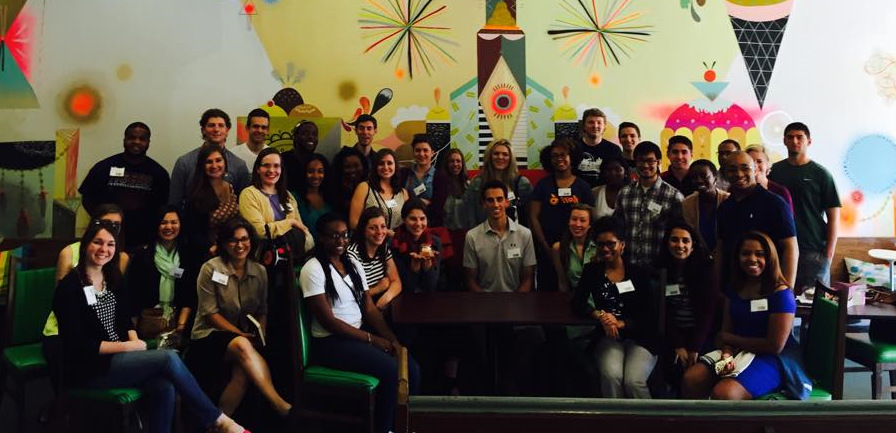
A picture of half of the Challenge Detroit finalists during our tour of the city with Detroit Experience Factory. These people are incredibly talented and smart and we were all very lucky to get to spend two days together.
I interviewed with three organizations: Mango Languages, Detroit Lions, and Edw. C. Levy Co. Every candidate also interviewed with a representative from Challenge Detroit. I had three interviews right off the bat – Challenge Detroit, Detroit Lions, and Mango Languages (in that order). Speaking of which, I remember the order of interviews being a big talking point for candidates. People openly weighed the pros and cons of their individual interview schedule – whether they were spread out, or had multiple in a row, or if the bulk was earlier or later in the day – most candidates had a good supporting argument for every scenario. It was a mental game born from nervous tension and we all played.
After my first three interviews, I really felt like I had done well. I felt like I spoke clearly, answered questions properly, and the conversations were informal, but productive. I went up to my room feeling much lighter so I made a few phone calls and prepped for my final interview with Edw. C. Levy Co.
Before the interview trip, each candidate was given the list of host companies and was asked to rank his/her top eight. Levy was on my list, but to be perfectly honest, I still didn’t really understand what they did. If I remember the job description correctly, they were looking for someone to work in marketing for their Agricultural division. I had worked with a few farmers in Madagascar and apparently felt like that justified my candidacy as a marketing associate in the agricultural division of a fairly large company. Long story short, it didn’t.
I interviewed with the Vice President of HR at Levy, who was incredibly warm, receptive, and easy to talk to. We talked about Peace Corps, my professional background, and life at Levy. 20 minutes into the conversation, I felt like I was going to go four-for-four on interviews and really have a good shot at becoming a fellow…
“Rory, I’m going to give you a scenario,” she said.
That was the start one of the most epic nervous cold sweats of my life. In Peace Corps we were given scenarios during our oral Malagasy language proficiency tests and those just weren’t for me.
“Your company has just created a drone bee…” she continued.
Oh boy.
“This drone bee can produce honey five times faster than a normal bee, but there is one catch,” she added.
Of course.
“The honey is purple.”
Uhhh….I’ve been out of the country for nearly three years. Are drone bees a thing now?
“Your company has asked you to go to a trade show to talk about the drone bee and sell the purple honey it produces. How would you market this product?”
…crickets…
I feel like I asked if the purple coloring could be harmful in any way or if the drone bees could pollinate, but I also don’t really remember most of my response due to an overwhelming surge of anxiety. I stumbled through some sales pitch that felt so disjointed I was sure I came across as an agricultural imposter.
Later that night and throughout the rest of the interview trip I hesitated to tell people, other candidates, and even current/alumni fellows that I interviewed with Levy because I was so embarrassed – as if they would have heard about my ridiculous response just by finding out the company name. I wanted to erase those few minutes from my mind and pretend it never happened. I was sure Levy felt the same way.
Two days later I had an ocean, two planes, and 23 hours to contemplate my responses to all of the interview questions, but that last one was all I thought about. At that point, I couldn’t even enjoy the success I had in the three other interviews because my thoughts were so consumed with Levy. Like most people, I was my own harshest critic. I felt like I could have been the next boom goes the dynamite guy if my response had been recorded and made public.
The trip back to Madagascar also gave me plenty of time to learn more about bees. For example, did you know that a drone bee is actually just another name for a male honey bee? Well, as I’m sure you gathered from my inner monologue above, I did not know that at the time. I thought the question was in reference to a new type of robotic bee, or similar unmanned aerial vehicle. Is it possible she could have meant both? To this day, I still do not know.
All 75 candidates were told not to expect an acceptance or rejection for several weeks, but I tried to get Internet in Madagascar as often as possible to check. I figured only the Lions or Mango would be interested in me, but with such an incredible talent pool, I was starting to prepare myself for the possibility of life without Challenge Detroit. It was a really long, stressful few weeks.
I think it was about three weeks later that I opened an email and saw this…
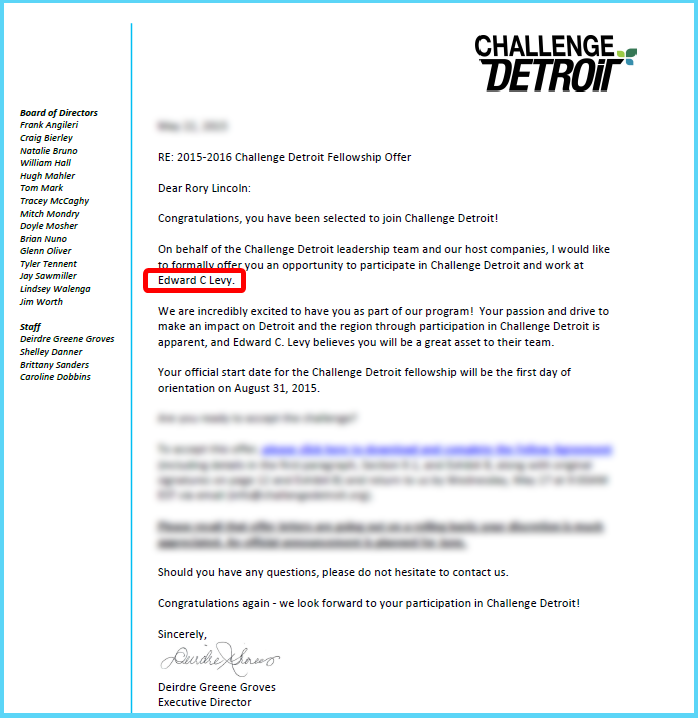
I couldn’t believe it! I felt as much shock and surprise as I did complete euphoria. I can’t even remember where I was when I saw the email because I was instantly overcome with so much adrenaline. I kept going back to the part where it said Edw. C. Levy Co and thinking ‘there’s just no way.’
And I was right. There was no way. Levy had offered the agricultural position to another, much more qualified fellow and all around good guy, Mike Kurfess.
However, they also decided to hire me on in a completely different capacity – one that I am significantly more comfortable talking about – training and video production. I was so grateful that the woman I interviewed with decided to look past my abomination of a bee answer and think only about the first 20 minutes of our conversation. For that, I will be forever grateful to Linda Wyatt and Edw. C. Levy Co. for taking a risk and giving me the chance of a lifetime.
So, moral of the story goes back to tip number four from Alyssa’s fantastic blog post – keep an open mind and never count yourself out. Your bee question might be coming and it might be the best thing that ever happens to you.
Footnote:
*Two fellows were accepted into Challenge Detroit via “the inside track” meaning they already worked at their host company and joined as a fellow.