Once Upon A Time…
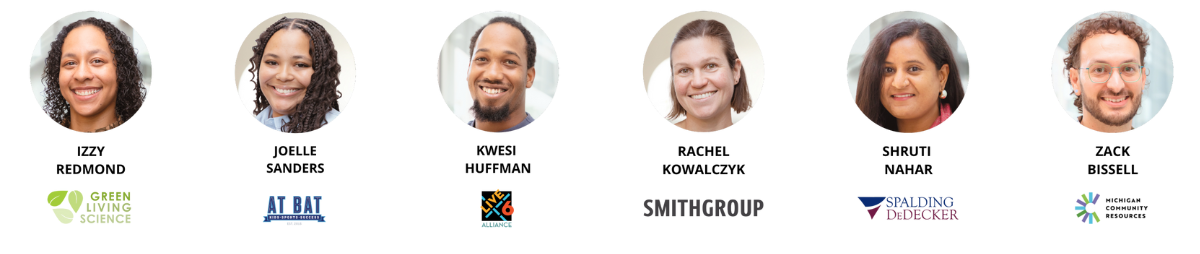
Ok that’s not really where we are going to start, but we are the Storytelling Team! Our team included Joelle Sanders, Rachel Kowalczyk, Shruti Nahar, Kwesi Huffman, Zack Bissel and Izzy Redmond. We spent the last seven weeks working with Urban Alliance Detroit on their storytelling process.
Kicking off our first Challenge Project, our team spent several weeks understanding UA’s mission and goals with regard to storytelling. Our design prompt was, “How might we capture student, alumni, partner and funder stories more consistently and effectively?”
We recognized early on that there is a wealth of stories to be captured—students, alumni, partners, mentors, volunteers, staff and parents. We wanted to create deliverables to support the UA Detroit team in capturing and sharing every story.
During our stakeholder interviews, we had the opportunity to talk with stakeholders and UA Detroit staff, as well as participating in a mentorship immersion experience to get a full understanding of UA Detroit’s current processes with storytelling. Through our conversations, we got an inside look at the full program and came away with some key insights that directed the remainder of our design process.
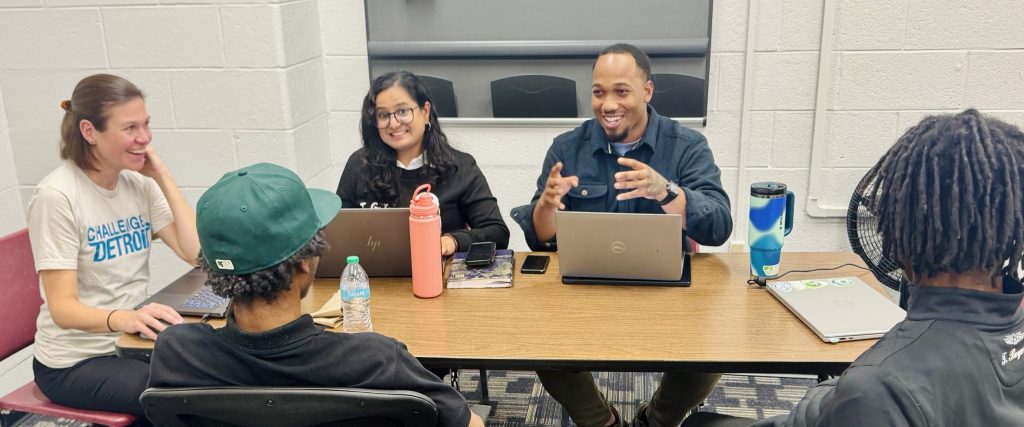
Rachel, Shruti and Kwesi engaging in one of our stakeholder interviews with one of Urban Alliance’s current students and an alum learning about their perspective on the programs storytelling.
We saw similar ideas reflected in all of our stakeholder interviews, but one really captured the focal point of our team’s objective. When we spoke to Victor Robinson, UA’s Director of External Partnerships, he told us “Seeing the impact [on the students] is the best way to engage people. Showing who they are when they come in and when they leave [the program] really makes a difference.” This became the north star for our work. We also came away from our interviews with three key insights that helped shape the scope of our work and create a clear direction for our deliverables:
- Relationships play a major role in gathering/telling the grounded and authentic impact stories UA wants to focus on.
- Capturing the stories that showcase the process of the entire program from all stakeholders perspectives in achieving the UA mission is the most important in showcasing the student impact.
- Our team had a real opportunity to assist UA in collecting retrospective, consistent, and accurate stories by providing tools, internal process, and increased capacity that ensured an increase in content capture and underutilization of storytelling moments.
Our goal then, was to create documents, plans, and tools that the UA could implement immediately, as well as ideas that could be expanded upon in the future to help capture the important student stories and create a content database to pull from at any time for effective storytelling.
In synthesizing these insights, our team took an approach that built on the pre-existing foundation of rich relationships and events throughout the year by creating a suite of planning and execution documents to build the framework to ensure content is captured from all stakeholders throughout the year.
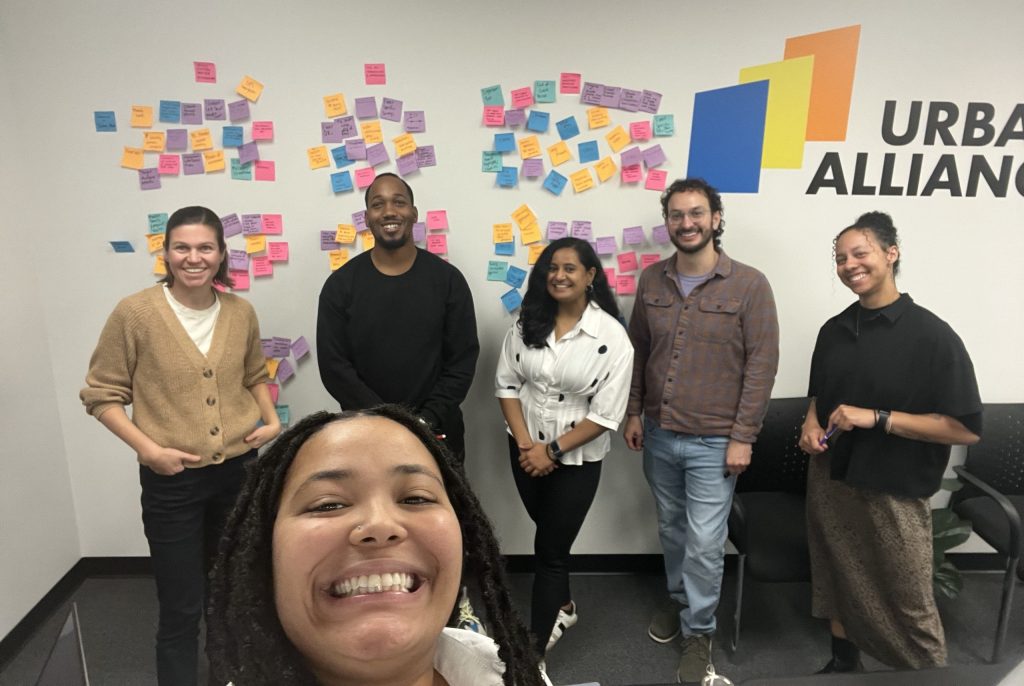
Our team posing for a selfie/an ussie in front of all our sticky notes after completing the ideation phase.
The suite of planning documents can be used to identify storytelling opportunities throughout the year. The documents include:
- Persona Profiles that outline various stakeholders, who they are, key stories that can be collected and highlighted for each one, and questions that could be asked of each one to generate content.
- Journey Maps that show major stakeholder intersections and events throughout the year as opportunities for content collection and gaps that exist.
- A Stakeholder Audit, Recommendations & Idea Bank which highlights what content is currently collected, gaps in collection, and ideas for future content collection, such as launching a Parent Council and ideas for events focused on storytelling from multiple perspectives.
- A Persona Connections for Content Generation Chart that synthesizes the timelines, events, and personas to help generate ideas for rich storytelling.
In addition to the ideation and planning documents, we wanted to provide a tool that can help ensure content collection and that would be immediately usable for UA starting the day of our final presentation. The idea is that the UA Team can use the ideation documents to determine the stakeholders and stories they would like to highlight, then use our Universal Media Capture Checklist to plan and execute media collection during events.
The Universal Media Capture Checklist is an immediately usable live tool that outlines what to capture, what stakeholders to focus on, and can track the person responsible and when they complete the collection and submission process. The team can use this document to identify the stakeholders to focus on, assign various media items to various team members, submit the documents directly to a folder using a link, and check off/initial when the media has both been captured and submitted.
The Checklist is also dynamic because it can be used by various stakeholders. If the UA Team ends up creating a Parent Council, a Youth Council, or hosting their own interns, the checklist could be used with them as well to contribute more community-driven content down the road. It is flexible to be used in various ways both in the current storytelling initiatives and ones to be developed in the future.
These tools ultimately provide a platform for story ideation, identification, and collection, and they feed directly into plans created by other Challenge Detroit teams, such as Social Media and Detroit Branding. The content collected under the processes that our Storytelling Team designed will be used to generate content for social media and for Detroit branding.
Before we end this blog, we want to show gratitude. We so appreciated seeing UA Detroit’s passion for the youth, community and their work. Hearing the youths’ story and seeing them take control of their future was incredibly empowering. Huge thank you to the UA Detroit team for being open and receptive to our recommendations, allowing us to learn about their programming to help share their stories. We couldn’t be more grateful for this first Challenge experience!
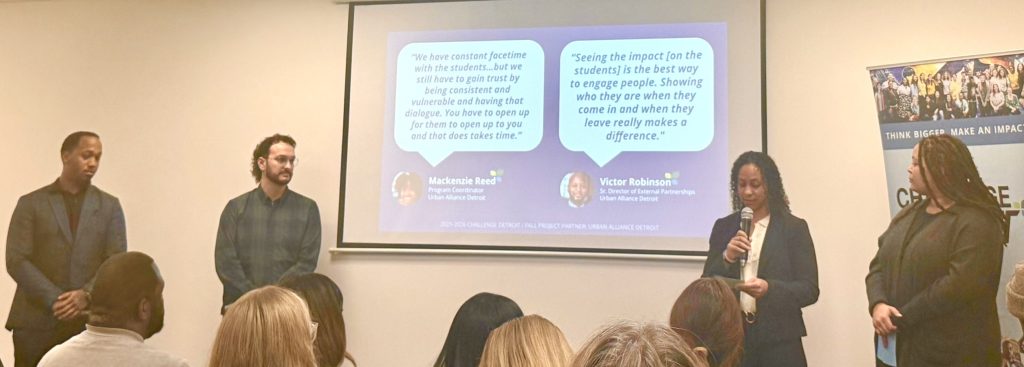
Izzy sharing key insights during our presentation.
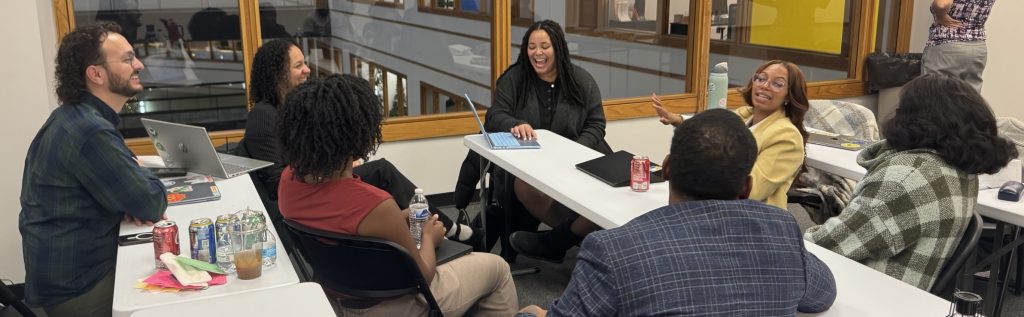
Sharing the final deliverables with our partners.
For our fall project we partnered with Urban Alliance Detroit, the local arm of Urban Alliance (UA), a national nonprofit creating pathways for young people to achieve economic independence through skills training, mentorship, and meaningful paid work experiences. Our project was focused on capturing and sharing UA Detroit’s impact through storytelling to expand opportunities for Detroit youth. Teams of Fellows worked alongside the UA Detroit’s team – Alphonso Amos, Victor Robinson, Keisha Powell-Young, Tamia Cooper, Jazmine Banks, Andrei Nichols, McKenzie Reed, Rashad Dudley – as well as engaged with stakeholders, including UA Detroit’s advisory board, students, employer partners, school partners and a parent.
See other team blogs about our project with Urban Alliance here.